Greek - Roman theatre
Back to all places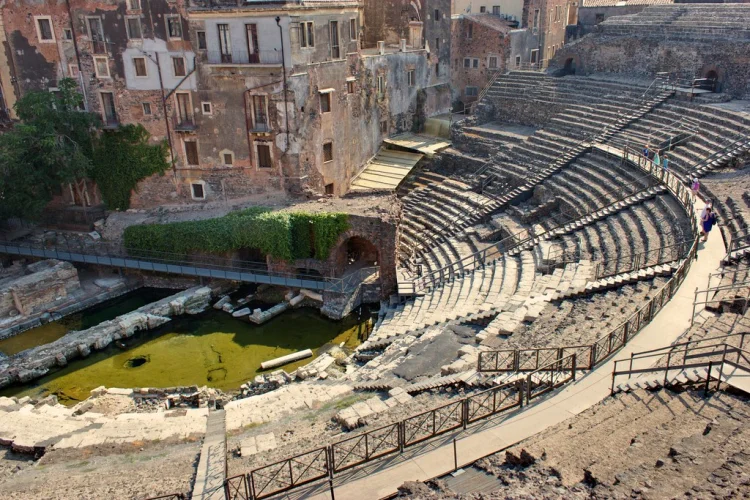
Constructed during the Hellenistic period and later modified during the Roman era, the Greek-Roman Theatre of Catania is a remarkable showcase of ancient architectural prowess.
The theatre was initially built in the 2nd century BCE, serving as a critical cultural hub for drama and musical performances. Following Catania’s integration into the Roman Republic, significant renovations occuured in the 1st century CE under Emperor Augustus, enhancing its capacity and design. The cavea, or seating area, could accommodate an audience of approximately 7,000 spectators, reflecting the importance of public entertainment in ancient society. Intriguingly, the theatre was strategically constructed using black volcanic stone, which was abundantly available due to the proximity of Mount Etna. The orchestra and stage areas were adorned with marble, showcasing the opulence and engineering techniques of the era. In medieval times, parts of the theatre were repurposed into private residences, and its significance waned. Rediscovery began in the late 19th century, spearheaded by local archaeologists and historians. These efforts have revealed not only the grandeur of the original structure but also a deeper understanding of the social and cultural dynamics of ancient Catania. The juxtaposition of Greek and Roman architectural elements encapsulates the transitional period from Hellenistic to Roman rule in Sicily.
Today, the theatre stands as a testament to the region’s rich historical tapestry, inviting visitors to ponder the civilizations that once thrived here.
Photo: Alexander Baxevanis
37.50269, 15.08366