Palermo Cathedral
Back to all places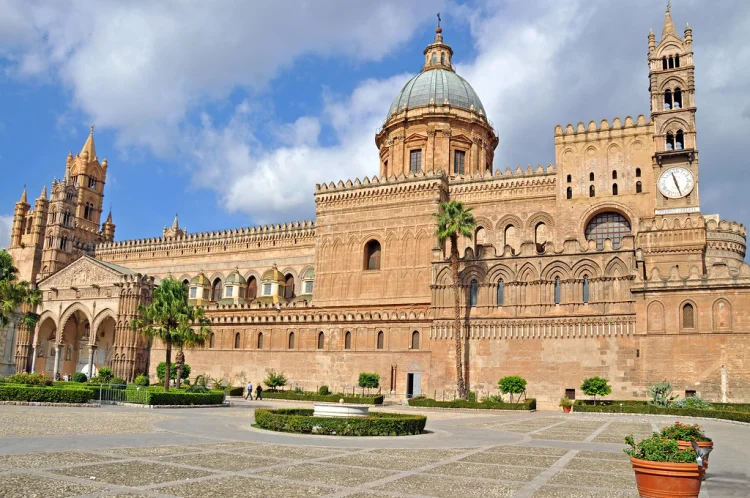
Palermo Cathedral, a monumental testament to architectural evolution, stands as a key historical and religious landmark in Sicily. Originally erected in 1185 on the orders of the Norman King William II, it replaced an earlier Arabic mosque that had itself supplanted a Byzantine basilica, showcasing a rich layer of cultural and religious transformations.
This sacred edifice is renowned for its eclectic mix of styles, blending Norman, Moorish, Gothic, Baroque, and Neoclassical elements, which mirror the diverse cultures that have influenced Sicily throughout the centuries. Significant historical events have transpired within its walls. The cathedral has been the coronation site of Sicilian kings and houses royal tombs, including those of Frederick II and Roger II, further cementing its role in the island’s regal heritage.
Over the centuries, it has undergone numerous renovations and additions, such as the 15th-century Catalan Gothic portico and the 18th-century Neoclassical dome designed by Ferdinando Fuga, reflecting ongoing stylistic shifts and the artistic currents of each period. The cathedral also possesses a treasure room that conserves relics and artifacts, including the famous crown of Constance of Aragon. Additionally, its role expanded beyond the religious and cultural when it served as a strategic astronomical site; the meridian line laid down in 1690 by the astronomer Giuseppe Piazzi for solar observations is still visible, highlighting the cathedral’s contribution to scientific endeavors.
Today, Palermo Cathedral not only functions as a place of worship but also as a museum and a pivotal historical site that attracts scholars and tourists alike, keen to unravel the layers of history encased within its venerable walls. Its status as a UNESCO World Heritage site as part of a group of nine civil and religious structures in Palermo further underscores its immense cultural significance and universal value
Photo: Dennis Jarvis
38.11433, 13.35605