Taormina
Back to all places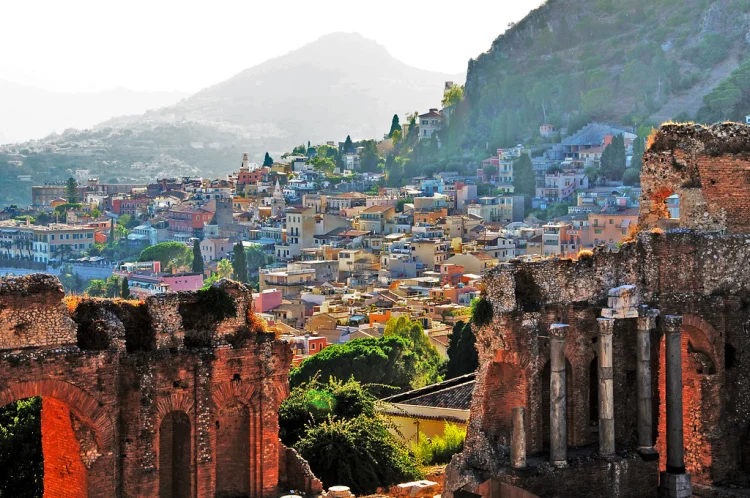
Taormina, positioned on the eastern coast of Sicily, showcases a rich tapestry of history that spans several millennia. Founded in the 4th century BC by Andromachus, the father of historian Timaeus, this ancient town has witnessed the rule of Greeks, Romans, Byzantines, Arabs, and Normans, each leaving indelible marks on its cultural and architectural heritage.
The stunning Greek Theatre, constructed in the 3rd century BC and later renovated by the Romans, stands as a testament to the town’s significance in antiquity, offering breathtaking views of Mount Etna and the Ionian Sea.
Over the centuries, Taormina became a prized location for European grand tour travelers, including Goethe and DH Lawrence, who found inspiration in its scenic beauty and historical richness.
The town’s medieval architecture, such as the Palazzo Corvaja, dating back to the 10th century, and the 13th-century Cathedral of San Nicola, reflect its varied past.
During the medieval period after the Norman conquest in 1078, Taormina flourished under the guidance of the Norman, then Hohenstaufen, and later the Aragonese reigns. In 1410, the town was the site of the Sicilian Parliament meeting, further cementing its historical significance. The arrival of the railway in the late 19th century transformed Taormina into a notable tourist destination.
Today, Taormina continues to enchant visitors with its blend of natural beauty, historical sites, and vibrant cultural life. Its picturesque streets, adorned with charming cafes and elegant shops, are set against the backdrop of ancient ruins and dramatic coastal scenery, making Taormina a mesmerizing destination that seamlessly connects the past with the present.
Photo: Luca Volpi
37.85455, 15.28894